Paperback Edition
Paperback
338 pages
$34.95
Choose vendor to order paperback edition
BrownWalker Press
Amazon.com
Barnes & Noble
Harvard Book Store
Return policy
PDF eBook
Entire PDF eBook
6017kB
$32
Get instant access to an entire eBook
Buy PDF Password
Download Complete PDF
eBook editions

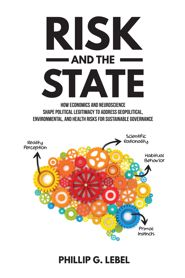
Risk and the State
How Economics and Neuroscience Shape Political Legitimacy to Address Geopolitical, Environmental, and Health Risks for Sustainable Governance

 Paperback
 eBook PDF
 | Publisher: | BrownWalker Press |
| Pub date: | 2021 |
| Pages: | 338 |
| ISBN-10: | 1599426102 |
| ISBN-13: | 9781599426105 |
| Categories: | Economics Business & Economics Psychology |
Abstract
Economics demonstrates how markets can serve as remarkably efficient institutions in allocating scarce resources. At the same time, incomplete information generates prices that can lead to a mis-allocation, producing in some cases too little while in others too much of a good. Matters become more complicated when striking a balance is influenced by our perceptions of risk. Here, neuroscience provides insights into which, and what kind of public sector interventions one should consider. While there are many types of risk – political, economic, financial, and environmental as individuals confront any crisis, our perceptions of risk can alter significantly the extent to which we look to public sector intervention as a response. In the short run, crises many be managed through greater public intervention while in the long run, economic fundamentals still drive key decisions, and thus the extent to which a given mix meets a test of political legitimacy.At a time of deepening partisan political divisions, the respective roles of the private and public sectors are once again in flux. These changing roles shape our notions of political legitimacy, especially in the presence of risk. Neuroscience provides critical insights on how we perceive risk, and in turn, make decisions. In this well researched book, economist Phillip LeBel explores the various roles of states and markets, with a focus on how we respond to key issues in managing public health and the environment.
In looking at the natural environment and public health, while perceptions of risk may shape short-term responses, the challenge we face over the long term is to craft incentives that promote sustainability and improved health of a society. Basic science always should guide public policy, even in the presence of risk. Reforming public sector institutions for greater transparency and accountability are important key steps in the respective roles of states and markets, for which some suggested changes are put forth here. In the end, personal and social identity depend critically on how we manage information to craft a sustainable, inclusive, and economically viable future.
The January 6, 2021 Capitol insurrection in Washington, D.C. reminds us of the need to establish a common understanding of scientific evidence and how this shapes our views of democratic governance. This book comes at a time when such an analysis is needed now more than ever.
REVIEWS and WORDS OF PRAISE
Listen author's podcast on topics covered in the book at Political legitimacy with Prof. Phillip LeBel Economics Explored by Gene Tunny.
See review at Peace Corps Worldwide by John Coyne (2021-Mar-29)
Applications of the theory of efficient markets often rest on limiting assumptions of full information and the rationality of agents. Yet, incomplete information, risk, and notably our perceptions of risk lead to inefficient market outcomes and misdirected public policies. This book by Professor Le Bel delves articulately into related issues at the intersection of economics and neuroscience and offers up a series of thought-provoking policy responses based on careful analysis and extensive research. An excellent read for economics and non-economists alike.
--Michael G. Plummer, Director, SAIS Europe, Eni Professor of International Economics, Johns Hopkins University
In this groundbreaking new book, the author integrates his vast experience in viewing economic and political systems around the world into a clear analysis of the diverse origins of political legitimacy. He goes on to demonstrate its importance in the ability of governments to confront the unprecedented challenges of the current era.
--Richard Vengroff, Professor Emeritus of Political Science, University of Connecticut, Counselor, CACCI
Having spent my career in international aviation politics, I am pleased to find such an insightful multidisciplinary analysis of policy perceptions of risk. LeBel's work takes full advantage of the latest neuroscience discoveries to test traditional economic views of risk. He sheds fresh light on the drivers of opposing political groups. In the process, there is much for the reader to consider as traditional views confront an emerging future.
--Paul V. Mifsud, Esquire, Former Vice-President of KLM International Airlines, Partner, Mifnet World Communications
About the Author
Phillip LeBel, Ph.D., is emeritus Professor of Economics at Montclair State University. With a career combining academic research, teaching, and professional consulting, Dr. LeBel has accumulated a record of expertise in several areas. He has published in energy and natural resource economics, institutional risk assessment, and management of financial institutions in the U.S., Africa, and Asia. Author of Energy Economics and Technology (Johns Hopkins University Press, 1982), this new book combines insights from ongoing research in economics and neuroscience to the formulation of sustainable public policy choices.
Paperback Edition
Paperback
338 pages
$34.95
Choose vendor to order paperback edition
BrownWalker Press
Amazon.com
Barnes & Noble
Harvard Book Store
Return policy
PDF eBook
Entire PDF eBook
6017kB
$32
Get instant access to an entire eBook
Buy PDF Password
Download Complete PDF
eBook editions
Share this book
Relevant events
NOV
19
4TH GENDERCONF
4th Global Conference on Gender Studies
4th Global Conference on Gender Studies
✨ Join us for an inspiring academic experience! ✨
Be part of the 4th Global Conference on Gender Studies, taking place on 19–21 November 2026 in beautiful Copenhagen, Denmark. This conference is...
✨ Join us for an inspiring academic experience! ✨
Be part of the 4th Global Conference on Gender Studies, taking place on 19–21 November 20...
19 - 21 Nov 2026
Copenhagen, Denmark
NOV
19
ISSCONF
3rd International Social Sciences Conference
3rd International Social Sciences Conference
3rd International Social Sciences Conference 2026
Dates: 19 – 21 November 2026
Location: Copenhagen, Denmark
Why Attend the International Social Sciences Conference 2026?
If you are passionate ...
3rd International Social Sciences Conference 2026
Dates: 19 – 21 November 2026
Location: Copenhagen, Denmark
Why Attend the International S...
19 - 21 Nov 2026
Copenhagen, Denmark
DEC
8
SCAP2026
10th Singapore Conference on Applied Psychology ‘LIVE’
10th Singapore Conference on Applied Psychology ‘LIVE’
Celebrate a Milestone with us at SCAP2026!
East Asia Research proudly announces the 10th Singapore Conference on Applied Psychology (SCAP2026), an extraordinary conference happening on December 8-...
Celebrate a Milestone with us at SCAP2026!
East Asia Research proudly announces the 10th Singapore Conference on Applied Psychology (SCAP2026...
08 - 09 Dec 2026
Singapore
Featured Events
NOV
23
GYNECOLOGYCONF
5th World Congress on Gynecology, Obstetrics & Women's Health
5th World Congress on Gynecology, Obstetrics & Women's Health
Scholars Conferences is excited to invite you to the 5th World Congress on Gynecology, Obstetrics & Women's Health. This year’s theme, “Innovations and Empowerment in Women’s Health: Advancing Care...
Scholars Conferences is excited to invite you to the 5th World Congress on Gynecology, Obstetrics & Women's Health. This year’s theme, “Innova...
23 - 24 Nov 2026
Bangkok, Thailand