Paperback Edition
Paperback
159 pages
$29.95
Choose vendor to order paperback edition
BrownWalker Press
Amazon.com
Barnes & Noble
Harvard Book Store
Return policy
PDF eBook
Entire PDF eBook
1913k
$24
Get instant access to an entire eBook
Buy PDF Password
Download Complete PDF
eBook editions

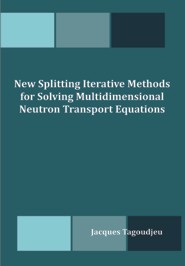
New Splitting Iterative Methods for Solving Multidimensional Neutron Transport Equations

 Paperback
 eBook PDF
 | Publisher: | Dissertation |
| Pub date: | 2011 |
| Pages: | 159 |
| ISBN-10: | 1599423960 |
| ISBN-13: | 9781599423968 |
| Categories: | Mathematics Mathematics Technology |
Abstract
This thesis focuses on iterative methods for the treatment of the steady state neutron transport equation in slab geometry, bounded convex domain of Rn (n = 2,3) and in 1-D spherical geometry. We introduce a generic Alternate Direction Implicit (ADI)-like iterative method based on positive definite and m-accretive splitting (PAS) for linear operator equations with operators admitting such splitting. This method converges unconditionally and its SOR acceleration yields convergence results similar to those obtained in presence of finite dimensional systems with matrices possessing the Young property A. The proposed methods are illustrated by a numerical example in which an integro-differential problem of transport theory is considered. In the particular case where the positive definite part of the linear equation operator is self-adjoint, an upper bound for the contraction factor of the iterative method, which depends solely on the spectrum of the self-adjoint part is derived. As such, this method has been successfully applied to the neutron transport equation in slab and 2-D cartesian geometry and in 1-D spherical geometry. The self-adjoint and m-accretive splitting leads to a fixed point problem where the operator is a 2 by 2 matrix of operators. An infinite dimensional adaptation of minimal residual and preconditioned minimal residual algorithms using Gauss-Seidel, symmetric Gauss-Seidel and polynomial preconditioning are then applied to solve the matrix operator equation. Theoretical analysis shows that the methods converge unconditionally and upper bounds of the rate of residual decreasing which depend solely on the spectrum of the self-adjoint part of the operator are derived. The convergence of theses solvers is illustrated numerically on a sample neutron transport problem in 2-D geometry. Various test cases, including pure scattering and optically thick domains are considered.
Paperback Edition
Paperback
159 pages
$29.95
Choose vendor to order paperback edition
BrownWalker Press
Amazon.com
Barnes & Noble
Harvard Book Store
Return policy
PDF eBook
Entire PDF eBook
1913k
$24
Get instant access to an entire eBook
Buy PDF Password
Download Complete PDF
eBook editions
Share this book
Relevant events
No upcoming events found for Mathematics
Want to add one? Submit your event here
Featured Events
NOV
23
GYNECOLOGYCONF
5th World Congress on Gynecology, Obstetrics & Women's Health
5th World Congress on Gynecology, Obstetrics & Women's Health
Scholars Conferences is excited to invite you to the 5th World Congress on Gynecology, Obstetrics & Women's Health. This year’s theme, “Innovations and Empowerment in Women’s Health: Advancing Care...
Scholars Conferences is excited to invite you to the 5th World Congress on Gynecology, Obstetrics & Women's Health. This year’s theme, “Innova...
23 - 24 Nov 2026
Bangkok, Thailand